artificial-intelligence
Starting With GPT-2: One Token at a Time
- gpt-2
- llm
- language-models
I wanted to understand large language models by getting my hands dirty, not by only reading about them. While looking for a model I could inspect end to end, GPT-2 felt like the right starting point: simple enough to run and study, but complete enough to observe the next-token interface used during generation.
GPT-2 also gives me a practical route into the Transformer ideas introduced by Attention Is All You Need. I can first make its one-token-at-a-time generation loop concrete, then open its attention, embeddings and other internal parts before comparing them with newer models.
Before starting, I already had the broad mental model. Give the model some tokens, ask it for the next token, append that token and ask again. What remained unclear was hidden inside the phrase "some deep learning."
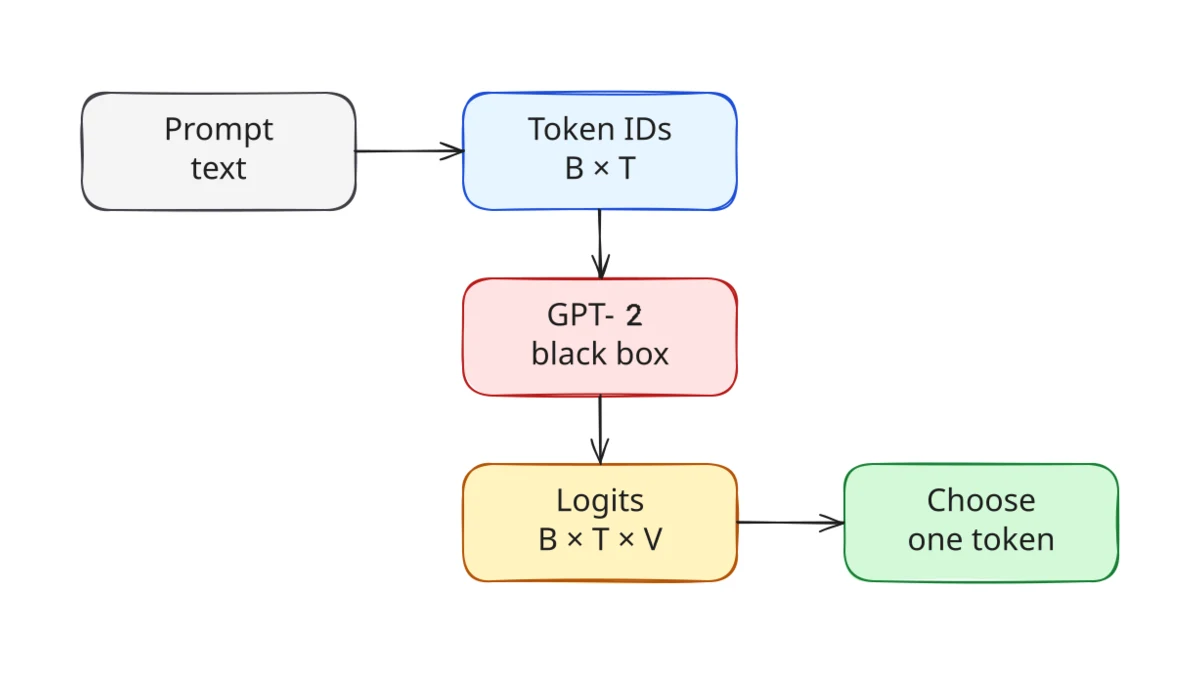
In this article, I am keeping that deep learning machinery as a black box. I want to trace one prompt through GPT-2, inspect its next-token scores and make the input and output contract concrete.
Start With a Prompt
I will use this prompt throughout the article:
The meaning of life is
Here is the smallest useful GPT-2 setup:
import torch
from transformers import AutoModelForCausalLM, AutoTokenizer

tokenizer = AutoTokenizer.from_pretrained("gpt2")
model = AutoModelForCausalLM.from_pretrained("gpt2")
model.eval()

prompt = "The meaning of life is"
input_ids = tokenizer(prompt, return_tensors="pt")["input_ids"]

with torch.no_grad():
    logits = model(input_ids).logits
The two from_pretrained calls hide some useful setup. If the files are not already cached, the Transformers library downloads the GPT-2 tokenizer files, configuration and pretrained weights from the Hugging Face Hub. The library contains the Python implementation of the GPT-2 architecture. The downloaded weights contain the values GPT-2 learned during training.
AutoModelForCausalLM reads the configuration, creates that architecture and loads the weights into it. It does not train GPT-2 on my machine.
The tokenizer turns the prompt into five token IDs:
[464, 3616, 286, 1204, 318]
Decoded separately, those IDs represent:
"The"
" meaning"
" of"
" life"
" is"
The spaces are part of the decoded token pieces. I am leaving the tokenization details for the next article. Here, GPT-2 receives these integers rather than the Python string.
The input_ids tensor has shape [1, 5]: one prompt with five token positions.
Using for batch size and for sequence length:
For this prompt, and .
Look at the Logits
The model returns a logits tensor with this shape:
[1, 5, 50257]
Using for the logits tensor and for vocabulary size, the general form is:
The base GPT-2 configuration uses . For this run, the shape means one prompt, five token positions and 50,257 vocabulary scores at each position.
I had expected one set of next-token scores. Instead, GPT-2 returned one set at every input position.
Each score answers a narrow question:
How suitable is this vocabulary token as the token that follows this position?
These scores are called logits. They are not probabilities yet and they do not need to add up to 1.
Why Take the Last Position?
When generating text, we want the prediction made after GPT-2 has seen the complete prompt. That is the final position:
next_token_logits = logits[0, -1, :]
Its shape is:
[50,257]
In this slice:
0: the first prompt in the batch.-1: the final token position.:: every vocabulary score.
In mathematical notation, that slice is one vector in :
For the five-token prompt, GPT-2 gives us five different prediction points:
| Position | Prefix available to GPT-2 | What its logits predict |
|---|---|---|
0 | "The" | The token after "The" |
1 | "The meaning" | The token after "The meaning" |
2 | "The meaning of" | The token after "The meaning of" |
3 | "The meaning of life" | The token after "The meaning of life" |
4 or -1 | "The meaning of life is" | The new token after the full prompt |
The first four positions predict tokens inside a sequence we already supplied. They matter during training, when GPT-2 learns from every position. During generation, position -1 is the one that continues beyond the supplied prompt.
Turn the Scores Into Probabilities
Softmax turns the logits into a probability distribution:
probabilities = torch.softmax(next_token_logits, dim=-1)
For vocabulary entry , the calculation is:
Here, is the logit for token , while the denominator includes all vocabulary logits.
The resulting 50,257 probabilities add up to approximately 1.
For this prompt, one checked run produced these leading candidates:
" not"   0.108805
" to"    0.082914
" the"   0.051284
" that"  0.048244
" a"     0.039578
Those numbers are from one checked run. They can change with the model revision and software environment.
Pick the Next Token
The simplest decoding rule is greedy decoding:
next_token_id = torch.argmax(
    next_token_logits,
    dim=-1,
)
This chooses the highest-scoring token. I do not need softmax before argmax because softmax preserves the ordering of the logits.
For the sample above, the selected token is ID 407, which decodes to " not".
Appending it changes the input from:
The meaning of life is
to:
The meaning of life is not
Repeat
To generate more than one token, we repeat the same operation in a loop:
generated_ids = input_ids

for _ in range(30):
    with torch.no_grad():
        logits = model(generated_ids).logits

    next_token_logits = logits[:, -1, :]
    next_token_id = torch.argmax(
        next_token_logits,
        dim=-1,
        keepdim=True,
    )

    generated_ids = torch.cat(
        [generated_ids, next_token_id],
        dim=1,
    )
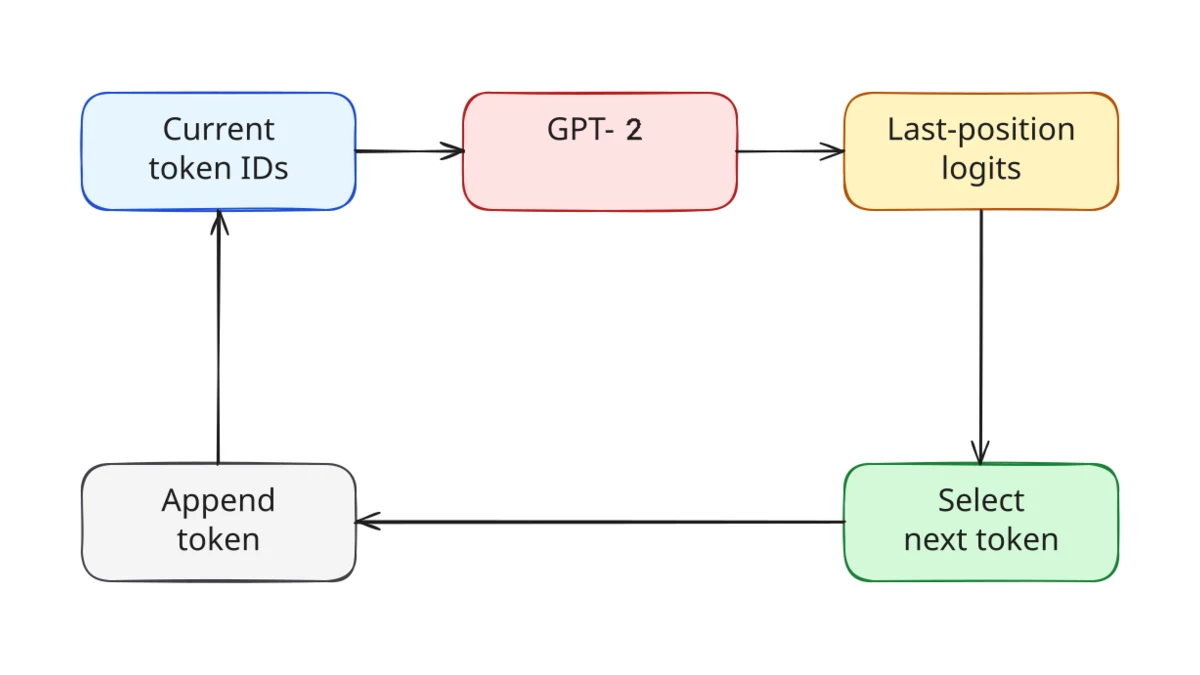
This code reruns GPT-2 over the whole sequence on every pass. Production inference can reuse earlier work, but that optimization does not change the next-token contract.
Greedy decoding can become repetitive because it always takes the locally highest-scoring option. Sampling and temperature would change the choice, not the loop.
The Black Box Is Still Closed
I stopped at these two shape transformations:
For generation, I kept the scores at the final position and applied a decoding rule:
What I Took Away
My starting model was right but incomplete. GPT-2 does not return only one set of scores for the whole prompt. It returns scores at every input position. The generation loop takes the last set, picks one token and runs again.
The next article in the series will open the first part of that black box: how the tokenizer turns text into the token IDs GPT-2 receives.