Understanding GPT-2 Token Embeddings
- gpt-2
- embeddings
- llm
Series contents
Part 3 · 3 published- Part 1GPT-2, One Token at a Time
- Part 2Understanding GPT-2 Tokenization
- Part 3Understanding GPT-2 Token EmbeddingsCurrent
In the previous article, I followed text through GPT-2's tokenizer and got token IDs. The next step was to turn each ID into a vector.
What I did not know was where that vector came from. Was the embedding created separately and then chosen for GPT-2? Or was it part of GPT-2 and trained with the rest of the model?
The Embedding Table Is Inside GPT-2
The token embedding layer is available at model.transformer.wte:
from transformers import AutoModelForCausalLM

model = AutoModelForCausalLM.from_pretrained("gpt2")
token_embedding_layer = model.transformer.wte

print(token_embedding_layer)
print(token_embedding_layer.weight.shape)
The checked GPT-2 Small model returned:
Embedding(50257, 768)
torch.Size([50257, 768])
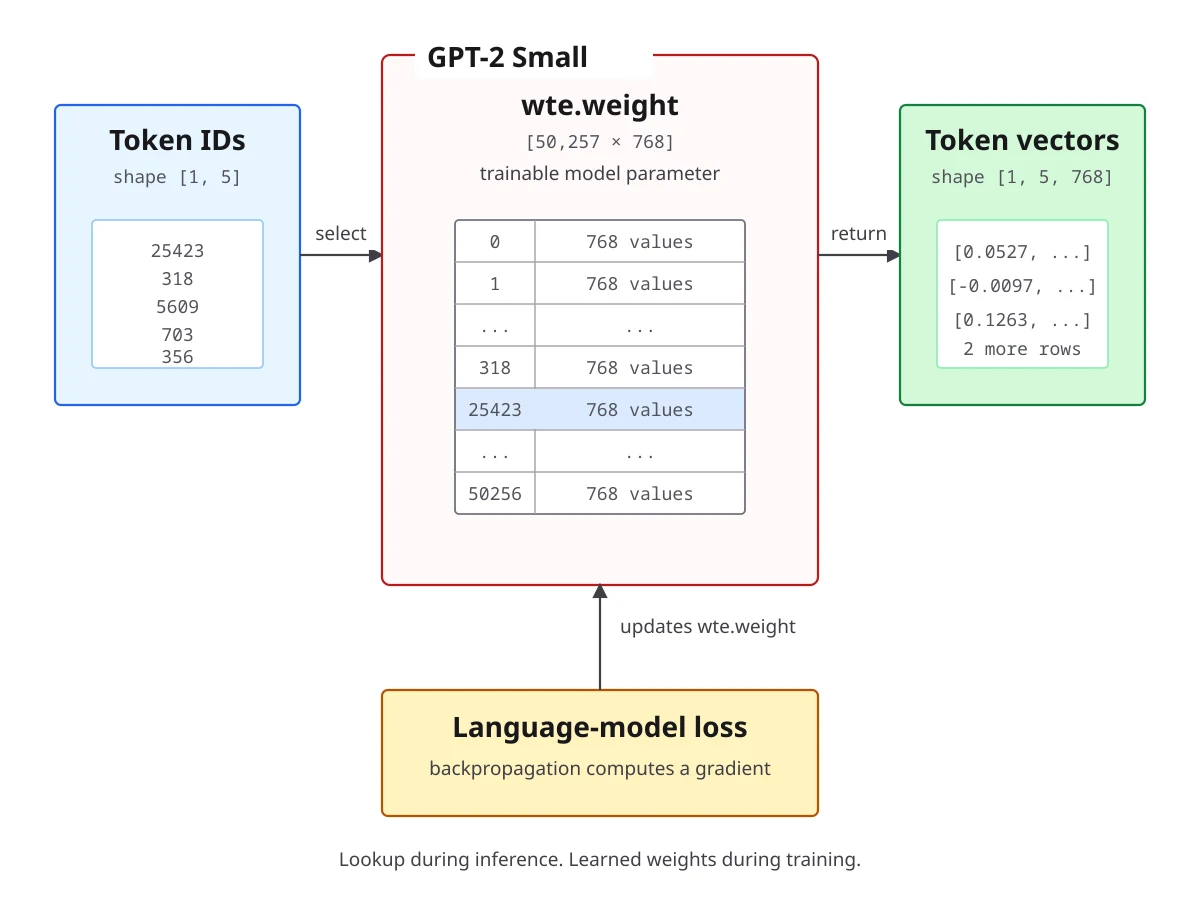
wte.weight is a matrix inside the model. It has one row for each of the 50,257 vocabulary entries and 768 values in each row. The GPT-2 configuration names 50,257 as its vocabulary size and 768 as its embedding and hidden-state size.
That matrix contains:
50,257 × 768 = 38,597,376
learned parameters.
Looking Up a Row
A small matrix makes the operation easier to inspect:
import torch

embedding_matrix = torch.tensor([
    [ 0.2,  0.7, -0.1],  # cat: 0
    [ 0.3,  0.8, -0.2],  # dog: 1
    [-0.8,  0.1,  0.5],  # car: 2
    [ 0.1, -0.4,  0.9],  # tree: 3
    [-0.6,  0.3,  0.7],  # computer: 4
])

token_ids = torch.tensor([0, 1, 3])
embeddings = embedding_matrix[token_ids]
The IDs select rows 0, 1 and 3:
tensor([
    [ 0.2000,  0.7000, -0.1000],
    [ 0.3000,  0.8000, -0.2000],
    [ 0.1000, -0.4000,  0.9000]
])
There is no calculation that turns the number 3 into the vector for tree. It means: retrieve row 3.
PyTorch describes nn.Embedding as a lookup table with learnable weights. GPT-2 uses the same operation at a much larger scale.
The Five-Token Prompt
I kept the prompt from the first article:
Software is changing how we
The tokenizer returns:
[25423, 318, 5609, 703, 356]
This tensor starts with shape [1, 5]: one prompt containing five tokens.
input_ids = tokenizer(
    "Software is changing how we",
    return_tensors="pt",
)["input_ids"]

embedding_matrix = model.transformer.wte.weight

manual = embedding_matrix[input_ids]
from_layer = model.transformer.wte(input_ids)

print(torch.equal(manual, from_layer))
print(from_layer.shape)
Output:
True
torch.Size([1, 5, 768])
Direct indexing and the embedding layer returned the same tensor. Each of the five IDs selected one 768-value row, so the new dimension appeared at the end.
For token ID 25423, which is Software, the first eight values were:
[0.052651, 0.010756, 0.010448, -0.022184,
 0.138050, 0.143493, -0.216310, -0.039968]
These values came from GPT-2 revision 607a30d783dfa663caf39e06633721c8d4cfcd7e with Transformers 5.17.0. Another checkpoint can contain different values in row 25423.
Learned With the Model
Finding wte inside GPT-2 answered where the table lived. The part that made this click for me was connecting it to backpropagation.
wte.weight is a registered model parameter and it requires a gradient:
wte_weight = model.transformer.wte.weight

registered = any(
    parameter is wte_weight
    for parameter in model.parameters()
)

print(registered)
print(wte_weight.requires_grad)
Both values are True.
A training step makes the connection visible:
model.train()
model.zero_grad(set_to_none=True)

loss = model(
    input_ids=input_ids,
    labels=input_ids,
).loss

loss.backward()

print(wte_weight.grad is not None)
print(wte_weight.grad.shape)
Output:
True
torch.Size([50257, 768])
The embedding matrix is not a separate fixed dictionary attached after training. Its values are weights learned with GPT-2.
The original OpenAI GPT-2 implementation defines wte inside the model, retrieves its rows for the input tokens and reuses the same matrix to produce output logits. Because of that weight sharing, the gradient in this check includes wte's output role too. I am only using it to confirm that the table participates in model training.
What I Took Away
I expected the embedding layer to produce a vector. I had seen embeddings used as separate components elsewhere, so I thought one might be added in front of GPT-2. That was wrong. GPT-2's embedding layer is part of the model and its weights are learned with the other parameters during training.
wte.weight contains one learned row for every token ID. Lookup selects those rows during inference and backpropagation updates the matrix during training.
The lookup still knows only the token ID. Token ID 318 selects the same row whether it appears first or last. The next part adds a second learned table so GPT-2 can also represent each token's position.